Enquiry handling: from form to CRM in seconds
An enquiry from the form lands in the CRM, the client gets a reply in their own language and the team gets a task with a deadline. No retyping, at any hour, and no risk of anything getting lost.
At a glance
| Process | handling enquiries from the forms on the website and on the promotion page |
|---|---|
| Tools | Make, Airtable, Gmail, Google Tasks, Google Sheets |
| Languages | Polish, English, Ukrainian — one process for three versions of the site |
| Result | a reply to the client within seconds, a CRM card with a 24-hour deadline, no retyping |
The starting point
Enquiries come in through the website form — in three languages, at all hours, including evenings and weekends. Without automation each one had to be read, copied into a spreadsheet, answered and remembered so that we could come back with a concrete proposal.
It is a typical process that in a small company depends on whether somebody happens to check the inbox. And an enquiry that waits until Monday is often with a competitor by Monday.
How it works
A filter lets through only genuine enquiries. A bot trap and data validation weed out spam before anything moves on.
The page confirms the submission straight away. The client does not wait for a reload or wonder whether the form worked.
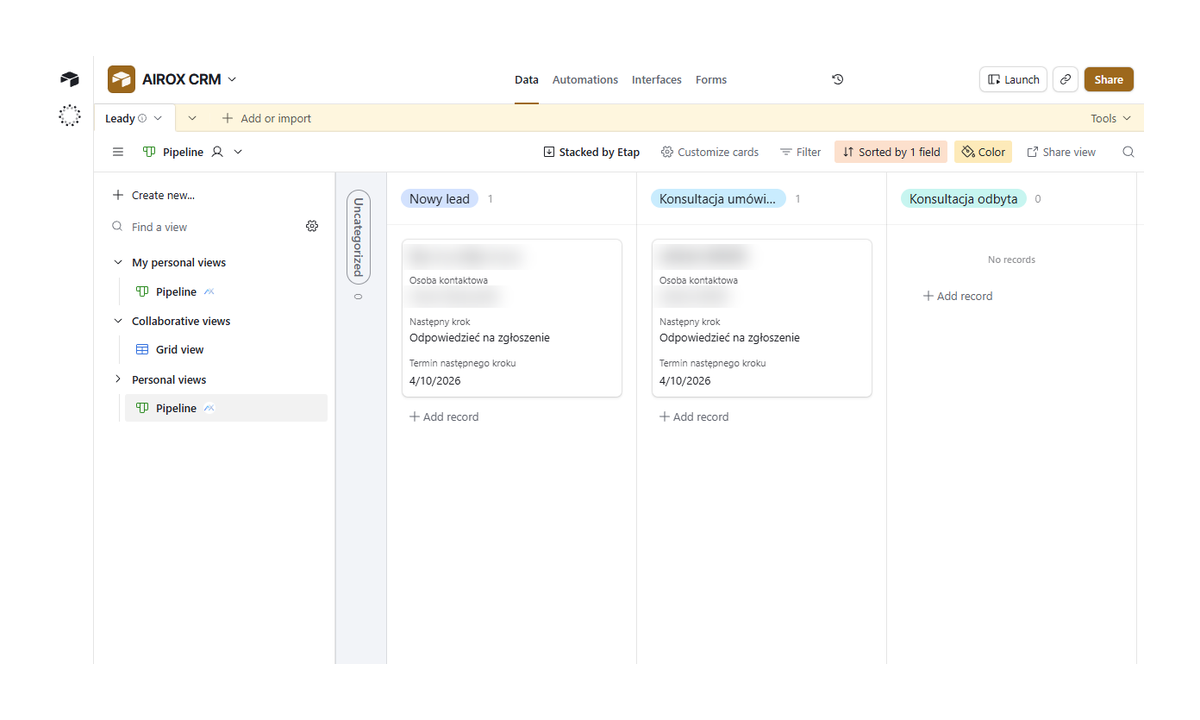
The enquiry lands in the CRM as a new card. With the language, the source — the main site or the promotion page — the stage “new lead” and the next step “reply to the enquiry” with a 24-hour deadline.
The team gets a notification with the full message, so the enquiry can be assessed without opening the CRM.
The client gets a reply in their own language — a confirmation plus a few questions about the process they want to improve. At the same time a task with a deadline appears on the team’s list.
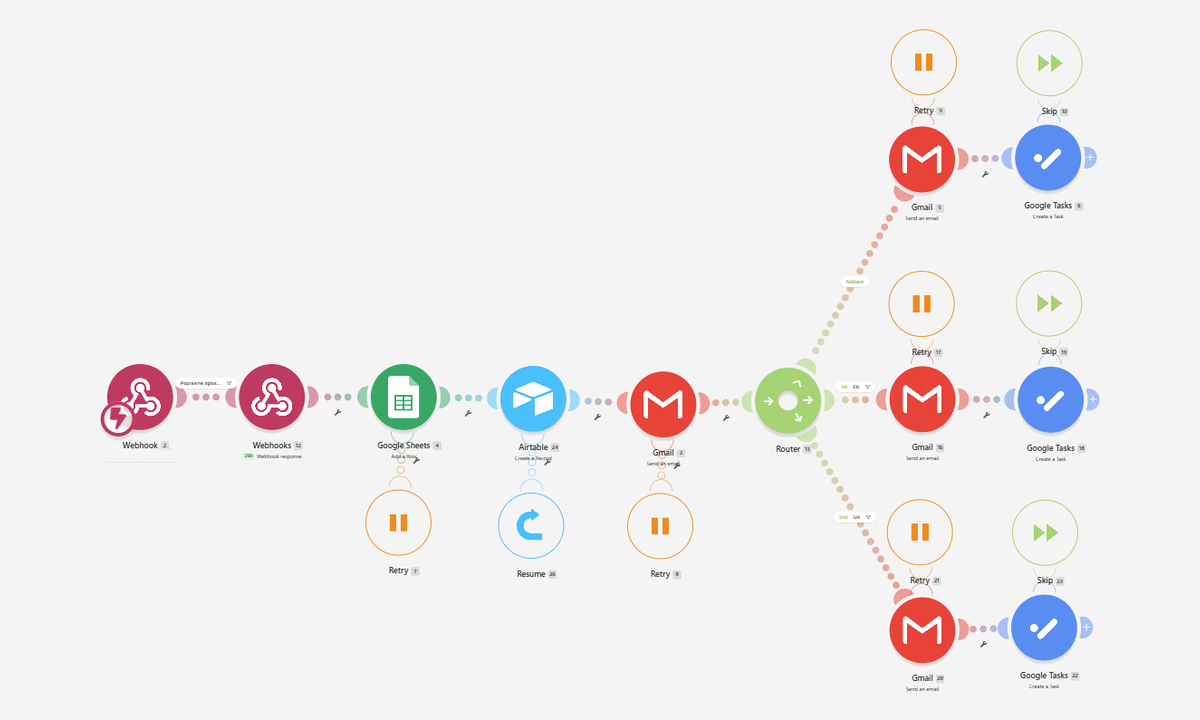
Every step has its own error handling: it retries, and if that fails, it lets the rest of the process carry on. A failure of one tool does not stop the whole flow.
All enquiries are also written to a spreadsheet. We kept it on purpose, as a backup during the move to the CRM — if the CRM does not respond, the enquiry is still saved.
What changed
- A reply within seconds, at any hour. The client knows the message arrived and when a person will be in touch — on a Saturday evening too.
- The first call starts with specifics. The questions in the automatic reply mean that before the meeting we know more than the form alone tells us.
- Three languages, one process. The client gets a reply in Polish, English or Ukrainian without anyone choosing a version by hand.
- No retyping. Form data goes into the CRM by itself, in the same fields, without typos.
- Nothing waits for someone to look. Every enquiry has a next step and a deadline, and the task appears on the list by itself.
- No lead gets lost. The backup and the error handling mean that even a failure of one tool does not cost an enquiry.
The first version of this process, still without a CRM, took five hours of work and two days of testing, and handled twelve enquiries in its first two weeks. We described the full numbers in the piece on how we automated our own enquiry handling.
Enquiries that do not end in a deal do not disappear from the CRM — they come back on the contact list after 30, 60 and 90 days. We describe that mechanism in the case study on meetings and getting back to clients.
Data security
The automation scenario runs in the European region of the Make service. Data in the CRM is stored by Airtable on servers in the United States, and it is transferred on the basis of Standard Contractual Clauses approved by the European Commission.
Every provider in the flow processes data only on our instructions. The full list with the legal bases is in the privacy policy, and the form points to it before sending.
What comes next
Today the system runs on rules only: the reply to the client is a pre-written text in their language. That is why the disclosure obligation under Article 50 of the AI Act does not apply to it.
The next step is a reply prepared by AI from the content of the specific enquiry. The client will then be told clearly that the first message was prepared by artificial intelligence — in line with the new AI disclosure obligation. Cases that need a person will still go to a person.